 According to all the books, all the websites and all the anecdotal evidence, there is a north-west trade wind that blows a gentle 15-20 knots all the way down the Portuguese coast. Always. We had watched the wind on various sailing weather apps for some days and indeed, these apps also evidenced that a north west trade should push us gently down the coast from Porto to Lisbon and beyond. Well all I can say is don’t believe all the experts; this is fake news and there is no trade deal with Portugal (except for port). Sanctions were in force on Aug 14 and trade was suspended as we set out from beautiful Porto for the 170 odd mile hop down to Lisbon. We set off at lunch time after refuelling with the motor on, expecting the trades to pick us up as we motored 20-25 miles off shore. Wind, what wind? Becalmed. Nothing for it, but keeping the engine on and settle down to watch the beautiful sunset and the stars come out.
  The stars at sea are actually amazing. There is no light pollution from street lights, cars or anything else, so you get a real unhindered view and with the right app on my phone I was able to profess some knowledge of the constellations. Just by pointing the iphone at the sky, it would come up with constellations, and stars I had never heard of, together with navigation information that is only surpassed by my faithful GPS. As luck would have it, we set off in the middle of the Perseid meteor shower, which offered additional heavenly activity, but seemed not to confuse my app (clever). It made for a spectacular evening, albeit rather noisier than expected with the engine running all night. As was becoming normal, dolphins turned up to offer some company for the lonely hours. Sailing through the night is pretty boring, but somebody has to be on duty at all times, watching for other boats and to ensure we avoid collisions. Amazing how in such a large expanse of water, boats seem to attract each other and close encounters are all too frequent and creep up on you with alarming speed. The dawn brought a sea mist and an oily looking sea with no wind. A gentle breeze did finally appear as we approached our destination of Cascais at the mouth of the Tagus river on which the capital city of Portugal sits, and we ended up with 17-18 knots as we entered the marina just to make the mooring a little more awkward.
Lisbon is another gem of a city. We are pretty close to Africa now and the influence of The Moors who invaded and built cities and castles all around. Sintra is an incredible castle built by The Moors on the highest, steepest mountain that is today populated by the contents of bus fulls of tourists, which came as quite a shock as we realised that we had been remote and out of reach of the tourist hotspots for many weeks and suddenly there were crowds and rules and prices to match! Sintra (which now also has an 18th century palace as well) and the castle in Lisbon were liberated from The Moors in 1147 by Don Alfonso Henriques aided by the second crusaders (a band of merry men from Dartmouth, England)., who laid siege to the place for 6 months and once the city was liberated, decided to abandon their crusade and stay.


Lisbon retains a strong moorish feel in some quarters but much of Lisbon was destroyed by an earthquake in 1755 and rebuilt with majestic squares and wide streets on a grid. The moorish quarter is now full of little eateries and hippy bars with Janis Joplin or Hendrix wafting out onto the narrow streets. The wide streets and boulevards how host shops and and banks and traffic. Jennifer left us after we had toured Lisbon and we were joined by Chris and Michelle from Padbury for a Genakker assisted meander down the coast to
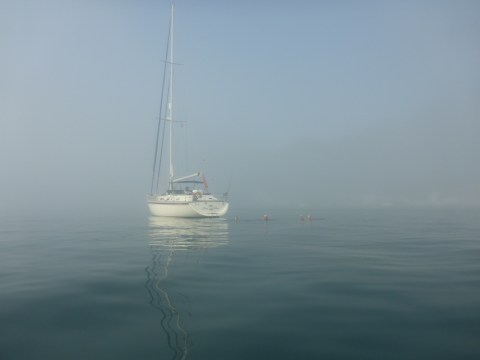 Arrabida, a beautiful sandy bay with a couple of restaurants (the absolute best bruschetta) and a mystical fog that enveloped the boat over night and on to Troia with a perfect anchorage. We sailed down towards Sines in a strange sea mist, which prevailed in a 7-10 knot breeze. Not really a trade wind, but wind from the right direction, for sure. Out of the mist came two blasts on a ships horn; not once, not twice but every 3-4 minutes. We replied with two blasts from our own horn … Turns out that two blasts on a ships horn means ‘I do not know your intentions’ and a reply of two blasts means ‘I am passing you to starboard’, which is what we were doing. Well that was lucky!
Sines is a lovely little town; we were back in off the beaten track Portugal with very few tourists and a castle overlooking the bay, in which Vasco da Gama was born. 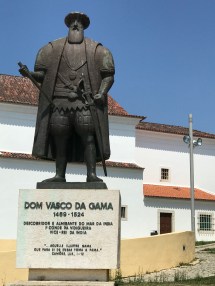 Vasco was the first European to actually reach India by sea (as opposed to Columbus who thought he had, but actually found America – a 14,500KM error) and became the first Viceroy of India. Goa remains strangely European with christian churches and pork on the menu, all because of Vasco, who was born in Sines, died in Cochin and is buried in Lisbon. Another intrepid adventurer from Portugal, who sailed with no GPS and no idea of where they were going. It makes our little adventure feel very tame. These little towns have great food, fresh and cheap. Adega de Sines is so full of character, run by a family in their bedroom slippers with grandpa on the grill (an open fire in the front room and grandma on the till. No menu, but a visit to the kitchen reveals choice of beef stew, portuguese beans or sardines or chicken from the grill. Grandpa clearly knows how to BBQ; it was delicious and prompted a gushing review on tripadvisor. Just across the street was some of the best steak we have had for some time; all in the shadow of a 15th century castle with canons and ramparts overlooking the bay below with the beach and the boat moored up in a safe marina. Does life get much better?


Sadly Chris and Michelle left us here and we also departed for Arrifana, another idyllic bay on the Atlantic coast which can only be criticised for the Atlantic swell which rolled in and from which we sheltered (to the most part) behind a cliff on which sits O Paulo a fabulous restaurant that we were to visit later. 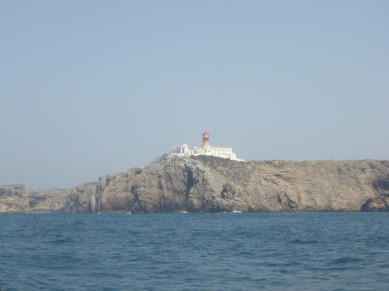 The next day we set sail with a reasonable breeze for Cape St Vincent, which would complete our journey south from Cape Finistere. Cape St Vincent is of course where Horatio Nelson spent valentines day in 1797 battling the Spanish fleet with some distinction (no dinner for 2 with Lady Hamilton) and it was his endeavours here that started got him noticed by the admiralty and set him on course for his fateful kiss with Hardy at Trafalgar. We anchored in Sagres, which bears the same name as al l the beer round here, opened a bottle and watched another lovely sunset. Next day was a 25 mile hp to Lagos, past Praia de Luz for our final destination. Lagos is back on the tourist map and rightfully so. The weather has suddenly changed; now 30oC++ the beaches are lovely, the surf is available round the corner at Sagres, but the waters are calm here. The town has an old world charm, albeit swarming with tourist shops, expensive restaurants and buskers. It is however a great place to unwind after the trip and to wait for our final guests

Donna and Howard popped along the coast from their home in Gibraltar / Mijas to join us for a weekend. Never having been on a boat before, much training was required .. this is a sheet, not a rope, this is a winch, not a drinks holder and so on … so focus was therefore on finding an anchorage for dinner, and finding fine restaurants for lunch, both of which we managed with some considerable success. A great finale to a wonderful 4 months. Now time to lift Sea Star out of the water and plan the trip home and to reflect on what has been an amazing 4 months.


 Sea Star goes South