I had always wondered, but never bothered to ask why a scallop in France is called a ‘St Jacques’ and in Germany a ‘Jacobsmuschel’ … Well, now, I know :-). St James, who was one of the 12 apostles ventured forth after the first Easter and spread the word. We all know that Peter ended up in Rome, but James ended up in Galicia. Although based in Galicia he returned to Judea in AD44 but was sadly beheaded, his remains, presumably in two parts were returned to Galicia, but lost en route. One part (the part with the feet) were found in AD812 supposedly covered in scallops just off the Galician coast.
This prompted two things; first the building of a cathedral that is rather outsized for the area in which to house and venerate said remains for eternity and secondly, scallops, which had a perfectly reasonable name in ‘Scallop’ were re-christened.
 The presence of James’ remains in Santiago popularised a pilgrimage by fervent believers to pop along to kiss James’ feet. The pilgrimage from many points in Europe and ending inSantiago is now trodden by nearly
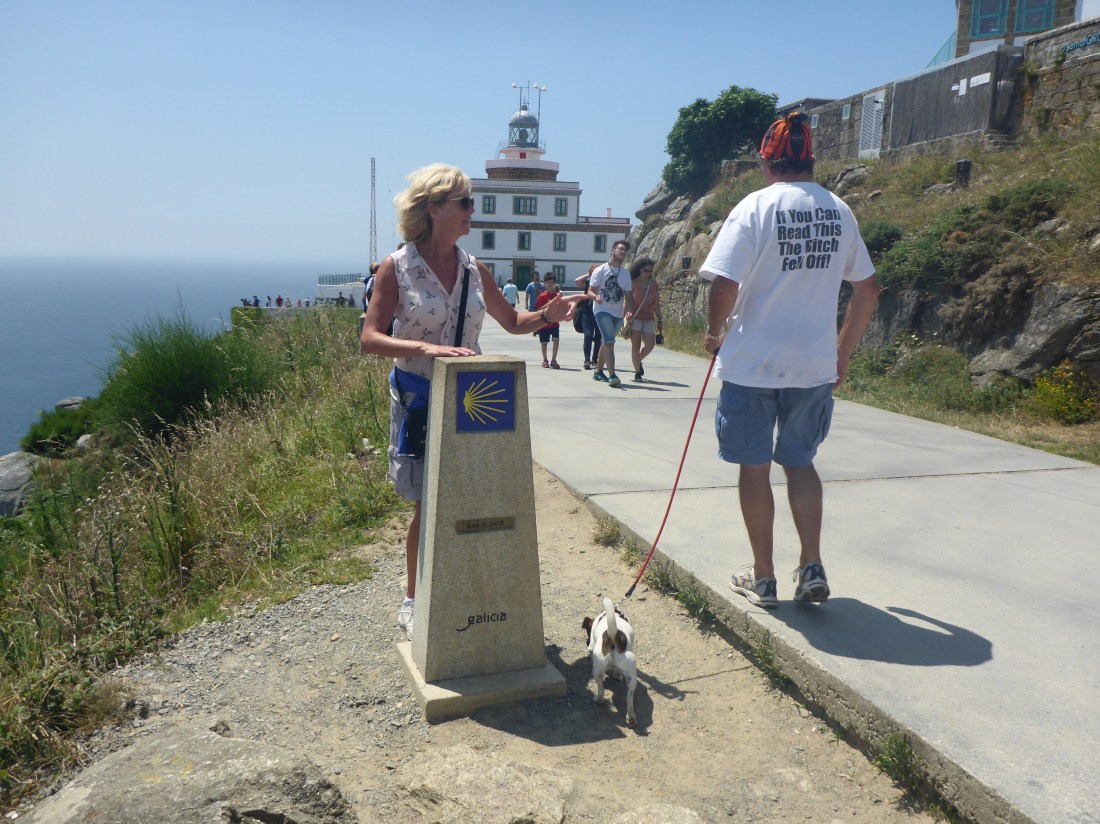
  300,000 pilgrims a year prompted by a papal declaration that pilgrims would benefit in the after life if they trod ‘The Way’ to Santiago and is now marked at regular intervals by a scallop shell and an arrow on many a footpath. Our pilgrimage by sea is by far the most difficult as the scallops that marked our way are hidden deep beneath the waves. We were joined for the final stages of our pilgrimage by our first live aboard guests (Steven and Helen – authors of the previous blog) who help us to complete not only the pilgrimage to Santiago, but indeed the optional extended pilgrimage to the end of the world aka Cap Finistere, which marks the end of the Costa del Morte, so named for the treacherous rocks and wild weather that has undone many a pre-GPS enabled sailor. Cap Finistere really does have the feeling of being at the end of the world, as its latin derived name implies. The furthest west point of Spain that looks out across the endless ocean to nothing beyond, into which Columbus ventured in 1492 and found the Americas. The seas were kind to us with 20+ knots of wind on the starboard quarter that pushed us along very nicely thank you.
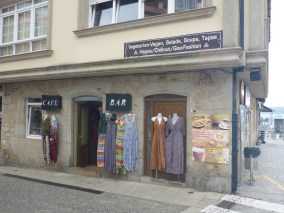
 We had moored up in Fistera, which was full of pilgrims, hostels and hippy shops. We had our first encounter of ‘Percebes’ (goose barnacles), a local sea food which was just a part of all the great food here … scallops (of course), sole, hake, razor clams, mussels … delicious.
 Once in Santiago itself, we met Lucas, a pilgrim from VIenna, who had all his worldly possessions in the roll of his trousers; no shoes so badly swollen feet, but he had an amazing operatic voice, which we encouraged him to demonstrate a number of times in exchange for a few glasses of wine and some tapas. He was a super interesting guy, but I somehow felt uncomfortable taking a photo … Aside from Lucas, these religious places are full of the more extreme end of humanity. religious fanatics, vying for the best position, nearest St. James’ remains, pilgrims; some of a religious journey but many on a life journey on the road, plus the inevitable tourist shops selling tat and postcards … all a far cry from the wilds of the seas off Cap Finistere.
In Santiago, we said goodbye to Helen and Steven , our first guests and with whom we travelled from A Coruna to the Rias, throughout the fiesta season, which disturbed a few evenings with fireworks (apparently the louder the better) until 4AM (yes 4AM), followed by a band with a big amp and a little talent. We enjoyed both 25knt winds and some very gentle days; so we left them a little sleep deprived but safely handed over to Spanish public transport. We also said hello to William and Nicola who arrived from Munich and with whom we would start our tour of the Rias