When we met William and Nicola in Santiago complete with two large suitcases and a hatbox, containing a new hat, we wondered if these landlubbers were going to hack it as we cruised the Rias on the northwest coast of Spain. The Rias are a series of 3 main and many smaller estuaries that indent the coastline on the top left hand corner of Spain and boast some of the most lovely cruising grounds in this neck of the woods with secluded beaches (some with ria views), national park islands and plenty of mussel farms which produce some of the most amazing mussels I have ever seen – a real meaty number … We were however delighted with the contents of said suitcases; curry spice mixes, haggis and a bottle of Clitoria, an interestingly named gin, which is a vivid blue in the bottle, but turns a gentle shade of pink on contact with tonic. A real party piece :-). After unpacking and sorting out the new guests on board, we pottered across the Ria de Muros to spend the night at anchor and spent time considering where we were gong to source fish for the first curry. William and Nicola are pretty dab hands at the curry and the skills of bhunaoing thrice and applying dunga (method No. 3), which are all explained in the little known curry bible “The Cooking Delights of the Maharajas’.
We had already pre-registered for access to the national park Islands of Isla Ons and Islas Cies, the former of which which protects the Ria de Arousa from the Atlantic swells, which roll in from the 3,800M deep Atlantic Ocean and deliver the west coast of Portugal and Spain with some of the best surfing beaches in Europe, but don’t do a lot for those of us who want to have a gentle sail down the coast in the direction of the Med.. To get to the next Ria, we had to put to sea; out of one Ria and into the next. After a few hours of relative calm, during which WIlliam and I calculated the volume of water in the earth’s oceans in cubic km (with ~1% accuracy), the wind got up and we christened the landlubbers with tacking into 25-30knts of wind with 2-3M of atlantic swell, which Nicola somehow slept though with the aid of some serious sea sickness tabs, but gave the rest of us and adrenaline fuelled afternoon. We arrived safely in Riveira, just up the Ria in good time to get the first curry on the go; an awesome fish in fenugreek. Sadly Riveira was pretty much closed for one of those fiesta things, so we headed for the beach on an isolated island in the middle of the Ria, which happened to be home to 1001 seagulls and their chicks, keenly protected by their screeching parents. So much for picnics on idyllic secluded beaches; to the contrary, Toby was in danger of becoming luch for the gulls. We did not stay long enough for that! 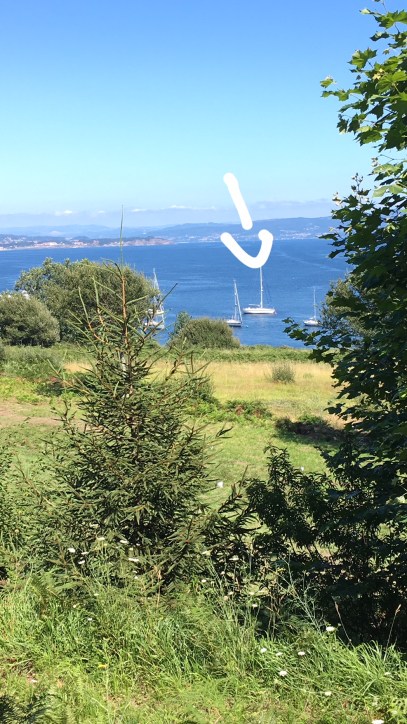 The next day, off to Isla Ons, which I have to say is very beautiful and pretty much un-touched save the eucalyptus trees, which I am sure are not a local species and a couple of really great restaurants overlooking the beautiful bay below and a beautiful view of the protected Ria. Every anchorage in the Rias seems to have a high proportion of Irish boats from Cork or Schull. What is it about Ireland that the Irish feel the need to be somewhere else so much of the time, setting up pubs or just sailing the Rias?
At the end of the week, we sailed up the Ria to Combarro with its proximity to Ponteverde and public transport links said Tschuss to William and Nicola and hello cobber to our guests from Sydney, Henry and Kate. 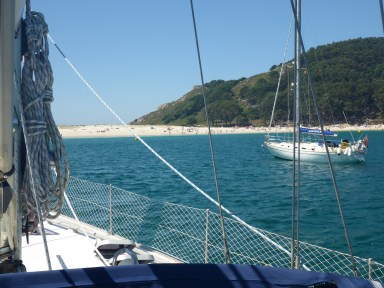 The previous month, Henry and Kate had been practicing sailing in the Whitsundays in Queensland on a cat, but were now on a proper boat with only one hull, albeit with a scent of indian curry.
 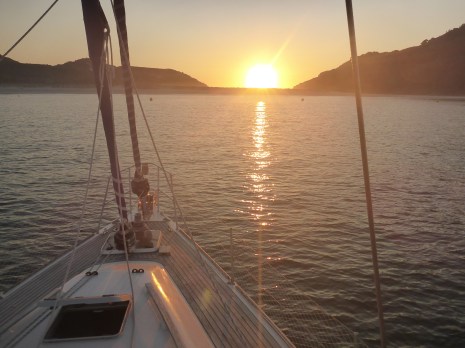 We returned to Isla Ons, found a mooring amongst the Irish boats walked up to the lighthouse after another lunch with a Ria view. On to Islas Cies via Portonovo, where were anchored in the prefect spot both for the lovely beach and the perfect sunset. It is very comforting that getting together with old friends (I have known Henry for almost 50 years, but not really seen him for 40 and it takes a boat in Galicia to motivate us both to rekindle the connection), just seems to just work, with no effort, you just slip back into a great friendship and even the partners get on well. It was getting hot in the Rias. 40oC; so we went past Vigo, under the bridge and into the virtual sauna with no wind but with the fabulous Restaurante Mauro (don’t miss it if you are in the area), with white table cloths and great food, where we were drawn inside for the aircon.
  Henry and Kate sadly left us in Vigo to return to the members bar of the Cricket Revival Australia Pub Interesting acronym); El Tobos wept and we sailed on .. destination Portugal via Baiona, where we collected our next guest after a short stop in Barras Bay, which is one of the first dog friendly beaches we have visited and certainly a lovely spot where the forest sweep down to the sea on a protected anchorage where the ria views were certainly all on display.

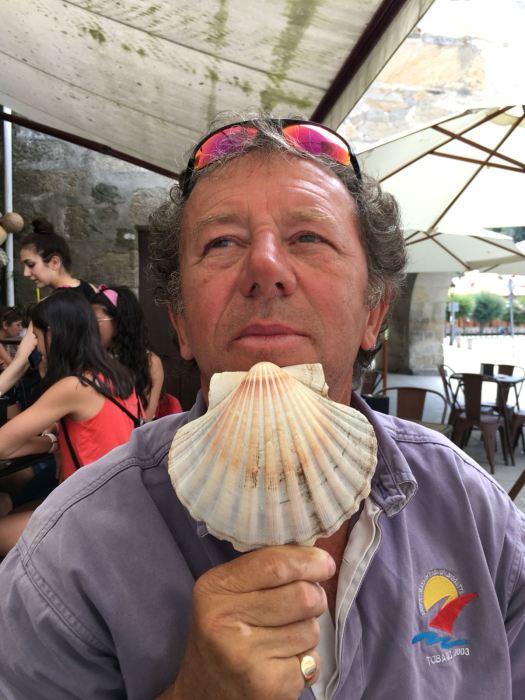
 The presence of James’ remains in Santiago popularised a pilgrimage by fervent believers to pop along to kiss James’ feet. The pilgrimage from many points in Europe and ending inSantiago is now trodden by nearly
  300,000 pilgrims a year prompted by a papal declaration that pilgrims would benefit in the after life if they trod ‘The Way’ to Santiago and is now marked at regular intervals by a scallop shell and an arrow on many a footpath. Our pilgrimage by sea is by far the most difficult as the scallops that marked our way are hidden deep beneath the waves. We were joined for the final stages of our pilgrimage by our first live aboard guests (Steven and Helen – authors of the previous blog) who help us to complete not only the pilgrimage to Santiago, but indeed the optional extended pilgrimage to the end of the world aka Cap Finistere, which marks the end of the Costa del Morte, so named for the treacherous rocks and wild weather that has undone many a pre-GPS enabled sailor. Cap Finistere really does have the feeling of being at the end of the world, as its latin derived name implies. The furthest west point of Spain that looks out across the endless ocean to nothing beyond, into which Columbus ventured in 1492 and found the Americas. The seas were kind to us with 20+ knots of wind on the starboard quarter that pushed us along very nicely thank you.
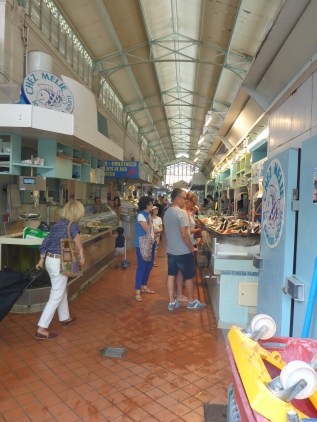
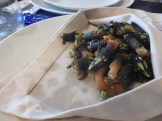 We had moored up in Fistera, which was full of pilgrims, hostels and hippy shops. We had our first encounter of ‘Percebes’ (goose barnacles), a local sea food which was just a part of all the great food here … scallops (of course), sole, hake, razor clams, mussels … delicious.
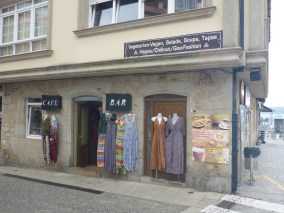 Once in Santiago itself, we met Lucas, a pilgrim from VIenna, who had all his worldly possessions in the roll of his trousers; no shoes so badly swollen feet, but he had an amazing operatic voice, which we encouraged him to demonstrate a number of times in exchange for a few glasses of wine and some tapas. He was a super interesting guy, but I somehow felt uncomfortable taking a photo … Aside from Lucas, these religious places are full of the more extreme end of humanity. religious fanatics, vying for the best position, nearest St. James’ remains, pilgrims; some of a religious journey but many on a life journey on the road, plus the inevitable tourist shops selling tat and postcards … all a far cry from the wilds of the seas off Cap Finistere.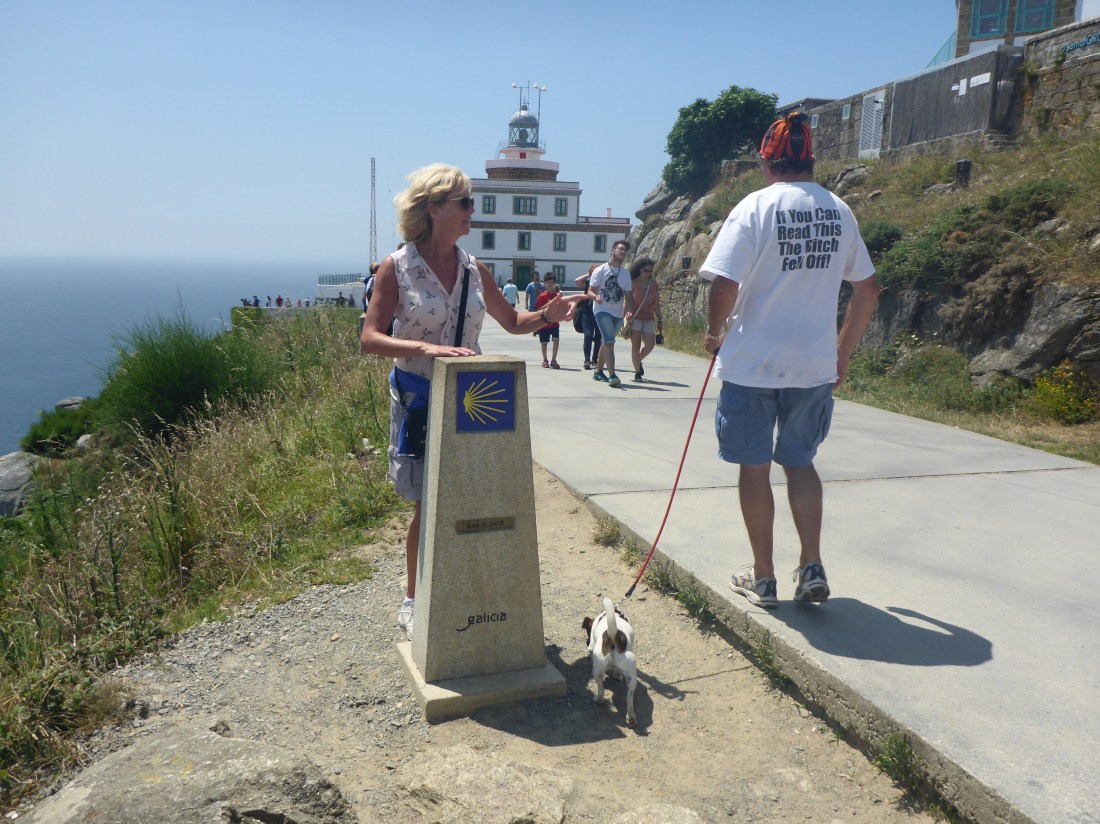
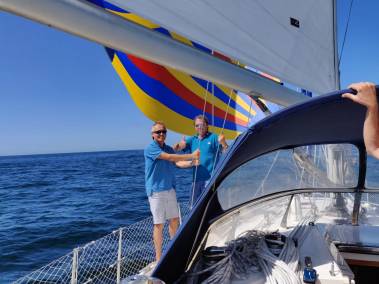 Now, dear reader, you may think a 48 foot boat is quite big but when there are four people and a dog vying for space in a restricted area that has an alarming tendency to rock n roll from side to side with some violence, you find yourself struggling to stay upright, never mind doing anything useful at the same time.
 Talking of sheets, you should see the toilets (sorry, heads). Tiny things that only take one buttock at a time, with liquid slopping around inside in severe danger of an unplanned exit and you aren’t even allowed toilet paper.
 Anyway, a week had passed and unfortunately it was time for us to go, so we said bon voyage to our wonderful hosts and went back to sunny England and normal size loos.
 For the last few years, we have got into the party mood in the summer with a pilgrimage to Glastonbury, which is so much more than just a music festival and more a festival of summer and arts and crafts from years gone by. It is all consuming and great fun. The only problem for those of us of a certain age, is the lack of sleep. A 3 day party without any real sleep can be a challenge. The summer is also Fiesta time in Spain, but unlike Glastonbury, Fiestas here seem to be in every town. Each town along the coast of Spain and probably elsewhere too has its own justification for a Fiesta such as the transportation of bulls to the bull ring in Pamplona (this happens in other towns too) or maybe to commemorate the return of local boy who went to America in the 18th century with nothing more that the clothes he stood up in and returned a millionaire and a survivor of the English fleets with his tobacco or sugar fortune with which he rebuilt the town, or even, in the absence of a local hero or a bull ring, just because the local priest decided to revere a certain saint back in the 14th century.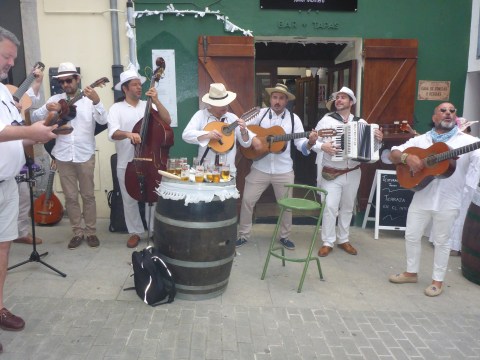
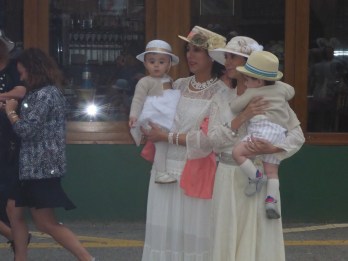 The Spanish are late starters in the evenings. Even when there is no Fiesta, many restaurants do not open until 9PM and you even find families turning up to eat after 11PM with kids, so when the Fiesta revelry gets going it will be well into the wee hours. You would have thought that this would put a strain on the metabolism of 50/60 somethings on a boat, but the Spanish have an answer for this. A good lunch in 25oC dappled shade with a bottle of wine results in a productivity drop in the afternoon, so unlike the puritanical North Europeans with a high work ethic, they do not try to power through the laws of nature, rather they go to bed for a kip. Perhaps doing anything productive is something the folk in these parts think about after the summer and summer is just the time for Fiestas? But not much seems to get done around here in terms of productive work; it seems to be either Fiesta or Siesta preparing for Fiesta.
 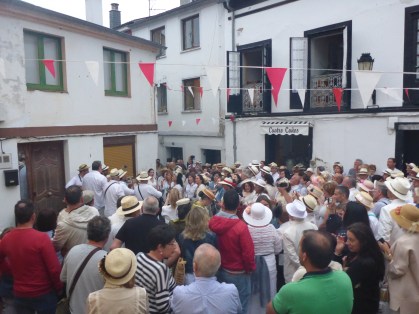 Everything in Spain shuts down from 2PM to at least 5PM and restarts later in the day. Some of you may be familiar with a similar retirement to bed culture in France, or at least Paris, in the late afternoon. The French “Cinq a Sept” may appear similar to the Spanish Siesta, but I understand is more energetic and does not re-energise for Fiesta, but rather exhausts for a early night. I somehow think that suggesting a Siesta in the middle of a working day at Dell will not get full management support, but it is very civilised and permits revelry (or indeed work) until the early hours, even for the kids .. it allows lunch to be digested without the stress of account reviews to give you heartburn, or worse and certainly after a bottle of wine in a for lunch is almost unavoidable …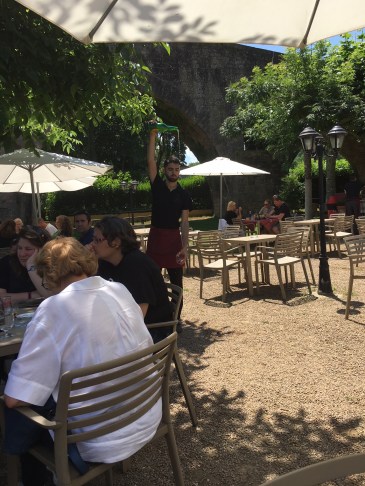
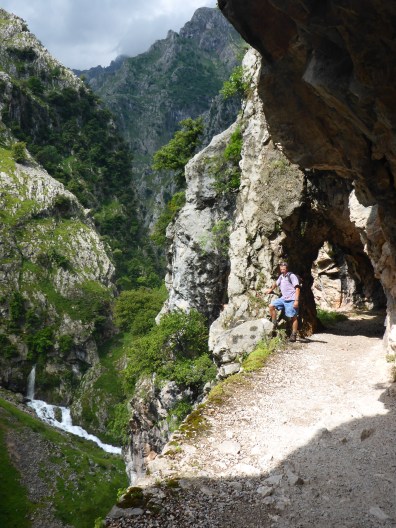 Next morning, map in hand, we started on the famous (at least around here) Cares route into the mountains; a well trodden path (Hemingway was probably here, before he wrote ‘Old Man and the Sea’), which started with a 850ft (260m) climb, which warmed us up, followed by about 10km of gentle walk through really spectacular gorges with glimpses of snow covered peaks and vertical drops to the river 1000ft below. Just under 3 hours each way with a ‘spag bol’ and an ice cream for lunch and total distance of 23kms; 35,660 steps and 210 flights of stairs celebrated in joyous fashion by Nicky’s fit-bit, which started writhing on her arm like a banshee. No mean feat….actually by the end of the day Nicky had extremely mean feet with angry looking blisters!!!!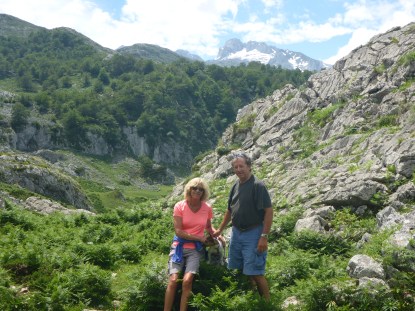


 Bilbao is capital of the Basque region. For quite a while, the Basques have been keen on independence from Spain (and I suppose France too), and with some justification. The Basque region, like Catalan is one of the economic wealth generators in Spain so they are good to go it alone, but Madrid wants to hang on to it (all those lovely tax Euros at stake). The Basques have a separate language, a distinct culture of their own, distinctive and rather fetching large beret hats (no I do not have one), their own flag and anchovies to die for. I guess you can draw parallels to Catalan (berets aside), to Scotland’s view on its membership of the UK (haggis, kilts saltire and bagpipes) and indeed to UK’s view of membership of the EU (intransigence, pot holes, failing public services and fish’n’chips). One difference is that Basqxit has a history of betrayal from the US and UK/France, as after WW2, the US, UK and France supported their cause only to realise that in fact, General Franco (Madrid head honcho) was an anti-commy, so in the atmosphere of The Cold War, the US (followed sheepishly by the Brits and the French) put all their diplomatic muscle behind anti-commy Madrid and in so doing betrayed the Basques and ETA was born. A few assassinations, bombings and tit for tat murders later, ETA has now calmed down, but there remains a distinctly independent Basque feel about Bilbao.
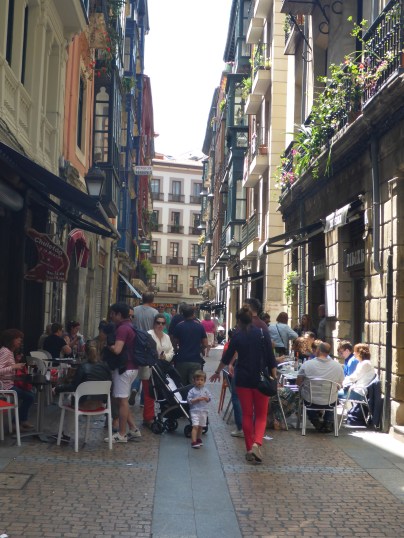 The tapas here is wonderful; cheese and ham croquettes, anchovies any way, sardines, calamaris and Sereno ham and did anybody tell you that the Spanish do great wine.. Rioja and Txakoli (a crisp dry white, pronounced Jack O’Lee, which has quickly become a firm favourite with Nicky) are made in the Basque country (another reason Madrid wants to keep it). So from a food and wine perspective, no issues and noticeably cheaper than La Rochelle and indeed UK (€3.50 for a beer and a glass of wine). Not brutally destroyed by allied bombers during WW2, loads of old bits remain, with streets too narrow for cars (actually more than the famous 7), littered with eateries, tapas bars and a very relaxed joie de vivre.
 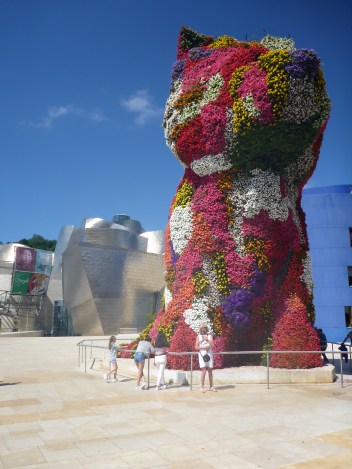 Bizarrely, there is a Guggenheim Museum here also, building designed by Norman Foster (he of HSBC HKG HQ fame) sat by the river; $100M building with a 20M high floral cat which would be completely out of place in most cities, but somehow works in Bilbao.
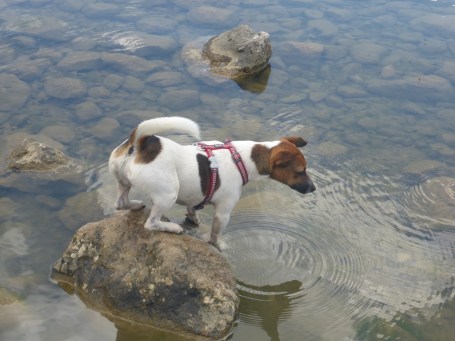
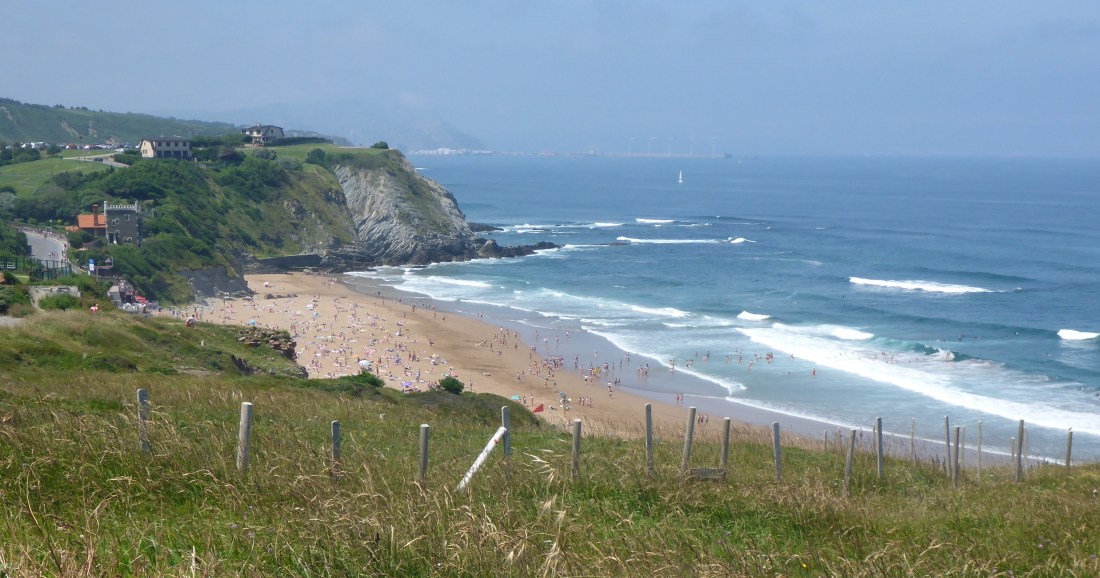 The weather is better than our arrival suggested it might be. We had a great day on the beach, once we found an unsupervised lovely little bay where dogs ARE allowed and Toby exhausted himself with other dogs and sun, sea and sand (another new experience for him)…still very weary of going out of his depth though!!
 wing a steady 15-18 knots.To those not in the know, that is a good breeze and one that will carry a 20 ton boat with two passengers and a dog at a steady 6-8 knots (6-8 nautical miles an hour – a nautical mile is just over an imperial mile; 1852 metres), which is a good comfortable speed. With the wind off the starboard bow (coming from front right), any more wind than that and it starts to get wet (spray everywhere as you bash through the waves), and bouncy which is fun for a while, but over a a day and a half would be very tiring and would mean that making tea becomes more awkward; any less wind and frustration sets in. So we were making good, comfortable speed. The fixed engine was off and we were on a direct line to Bilbao. The forecast was good and the wind was expected to veer (go clockwise around the compass) coming from SW (now) and moving to W as the day progressed into night, which would help us and make sailing more comfortable so all was good. Again, sorry to those that know all this, but the fastest and most comfortable wind for a sail is when the wind is coming from about sideways on to the boat to about 30 degrees from the back of the boat. If the wind is directly behind you, the boat tends to roll a lot on the waves and obviously you cannot sail directly into the wind …
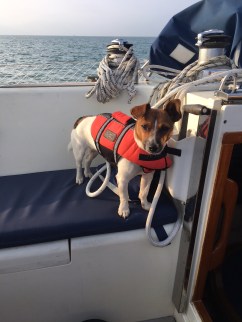
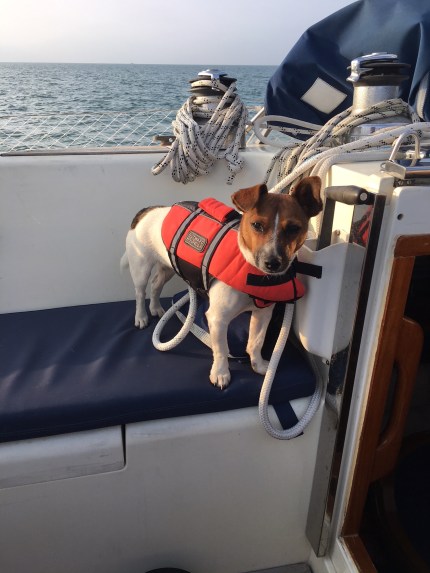 He is not a natural sailor. The compulsory lifejacket did not help. He remained unsettled for the whole trip and somehow managed to keep his legs crossed pretty much all the way. I think his tummy was in a knot. We sorted out the watches, which are the times when one of us is on duty, while the other sleeps. You cannot leave any boat at sea to its own devices, as although most of the time not much happens, when it does you need to do something. Hitting another vessel because you were slumbering is frowned upon in the marine community. Not changing sails when the weather changes (which it can do at night) can be dangerous, so somebody is on duty all the time; 24 hours a day.
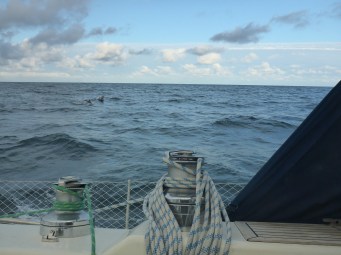 There are plenty of birds that fly within inches of the waves with incredible skill, picking up sardines or other sea life that ventures too close to the surface. And if you are lucky, dolphins appear (as in the photo; left) and play around the boat for a while before disappearing as quickly as they appeared. Surprisingly, there was very little in the way of boats or ships on this course. Normally you can see one or two vessels on the radar (or AIS), which has a range of 15-20 miles, but for most of the trip; nothing. One of the great things about sailing is no traffic, no traffic lights and no road rage whatsoever. I checked the chart again; could the lack of any other vessel be because we were in the French military practice firing range as sitting ducks, about to supplant Brexit on the front page of the Daily Mail as the innocent, but stupid victims of an international incident as aFrench flagged Typhoon jet swoops out of the sky at Mach 2 blows us out of the water? Nope … just no ships. As we approached Bilbao, traffic started to appear, but on the way, for 24h, almost nothing.


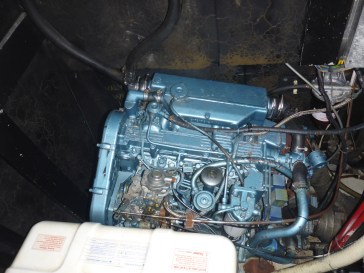 The engine bay is full of oil. A vacant look on my face. Mind full of expletives, but no clever ideas. Engine was professionally serviced over the winter; this is not a problem of neglect. So; no engine, no wind and no sight of land. The sails just flapping. We are not in any immediate danger, but we need to go back somehow … We radio a passing square rigger, but after enquiring if there is a life threatening situation (negative) they give us the gallic shrug and pass into the haze. Hmm, c’est la vie. We wait for some wind; the forecast had been promising. After perhaps an hour or so, there was a ripple on the water coming from the north, hopes rise … yes, a lift .. We set course for the lighthouse we had passed a couple of hours earlier. 2 knots of wind soon rises to a healthy 12-15 knots and we begin to make progress towards the lighthouse. The tide has turned, so we get help from the current. Things are looking up. Just past the lighthouse is St Dennis d’Orleon that has a small harbour accessible a couple of hours either side of high tide (high tide is at 16:45). We reach the lighthouse about a mile off and the wind drops to nothing again. So again; no engine, no wind so we drift with the current. This time, just a mile off a lighthouse and the rocks on which it sits and flashes warnings to passing ships of the danger of the rocks below. Oh!
 Sea Star goes South